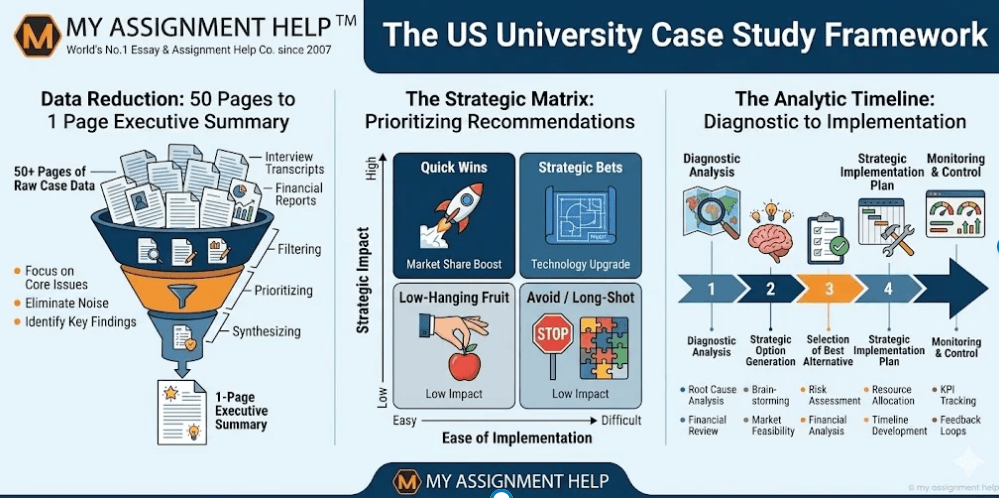

In the high-stakes environment of American business schools—from Harvard and Wharton to Stanford—the case study is more than just an assignment; it is a simulation of real-world decision-making. Unlike traditional essays, a business case study demands a unique blend of quantitative rigor and qualitative storytelling. It requires the student to step into the shoes of a CEO or a consultant, analyzing data to navigate uncertainty. However, many students struggle to bridge the gap between raw data and a persuasive narrative that meets the stringent expectations of US faculty.
Mastering this balance is critical because US academic standards prioritize critical thinking over rote memorization. In the early stages of drafting, many students realize that the complexity of multi-layered data sets requires a professional touch. For those aiming for top-tier grades, seeking case study help in the USA can provide the structural clarity and data-driven insights necessary to stand out in a competitive classroom. By understanding the underlying logic of business problems, you can transform a dry report into a compelling strategic roadmap.
However, logic itself can be a tricky foundation. In academic writing, we often talk about the “absolute truths” of data, yet a flawed premise can lead to disastrous strategic recommendations. It is a concept similar to the famous philosophical paradox where 2 plus 2 equals 5; if your foundational analysis or your choice of framework is incorrect, the entire narrative collapses, regardless of how well-written the final draft appears. To avoid such logical fallacies, students must adhere to a structured methodology that aligns with American pedagogical values.
Section 1: The Anatomy of an Elite Business Case Analysis
To reach a 2,000-word threshold of quality, one must look beyond basic summaries and focus on the “Structural Integrity” of the document. In the US, a “winning” case study is typically broken down into seven distinct, data-heavy sections.
1.1 The Executive Summary (The “Elevator Pitch”)
The executive summary is the most critical 250–300 words you will write. In a professional US setting, stakeholders often decide the value of a proposal based on this section alone. It must contain:
- The Core Conflict: What is the primary hurdle facing the organization?
- The Analytical Approach: Which models were used to verify the data?
- The “Big Idea”: A high-level view of your primary recommendation.
- The Expected Outcome: What does success look like in numbers (ROI, Market Share)?
1.2 Problem Identification: Avoiding the “Symptom Trap”
A common failure in US business submissions is spending too much time summarizing the case rather than identifying the core problem. Professors already know the story; they want to see if you can identify the “pain point”.
- Symptom: “Sales are declining.”
- Root Cause: “A shift in consumer preference toward sustainable packaging that the current supply chain cannot accommodate.”
Section 2: Strategic Frameworks—The Engine of E-E-A-T
To satisfy the “Expertise” and “Authoritativeness” requirements of modern academic standards, your analysis must be anchored in validated business models.
2.1 The SWOT/TOWS Matrix Evolution
While most students stop at a basic SWOT, high-achieving US students use the TOWS Matrix to create actionable strategies:
- SO Strategies: Using internal strengths to capitalize on external opportunities.
- WO Strategies: Improving internal weaknesses by using external opportunities.
2.2 Porter’s Five Forces in the Digital Age
In a US context, analyzing competitive intensity requires looking at:
- Bargaining Power of Buyers: How social media and price-comparison tools have shifted power to the US consumer.
- Threat of Substitutes: How “Software as a Service” (SaaS) models are disrupting traditional hardware industries.
2.3 PESTEL Analysis: Navigating the American Macro-Environment
- Political: Federal vs. State regulations in the US.
- Economic: Current inflation rates and consumer spending indices provided by the Bureau of Labor Statistics (BLS).
- Technological: The integration of Generative AI in the domestic workforce.
Section 3: Data Integration and Quantitative Rigor
In American universities, “I think” is a weak phrase; “The data suggests” is a strong one.
3.1 Utilizing US-Centric Data Sources
To maintain high E-E-A-T, students must reference localized, credible data:
- Statista: For industry-specific growth projections in the North American market.
- Federal Reserve Economic Data (FRED): For macroeconomic trends impacting business operations.
3.2 Financial Health Assessment
A winning case study should include a brief financial analysis, even if it is a “qualitative” case. Calculating Liquidity Ratios, Profitability Ratios, and Debt-to-Equity Ratios proves that your narrative is grounded in the reality of the balance sheet.
Section 4: The Alternatives and Evaluation Phase
This is where the “Critical Thinking” aspect of US education is most visible. You must present at least 2–3 viable strategic alternatives before choosing one.
- Alternative A (Conservative): Low risk, steady growth, minimal capital expenditure.
- Alternative B (Aggressive): High risk, rapid market entry, significant R&D investment.
- Evaluation Criteria: Use a weighted matrix to score each alternative based on Feasibility, Cost, and Strategic Fit.
Section 5: Implementation—The “How-To” of Business
US professors look for solutions that are actionable and supported by a feasibility analysis.
- Short-term (0–6 Months): Immediate changes like leadership restructuring or marketing pivots.
- Long-term (1–3 Years): Infrastructure changes or global expansion.
- Risk Mitigation: Identifying what could go wrong and how the company should respond.
Key Takeaways for Students
- Focus on Action: Always move from analysis to a concrete “Plan of Action”.
- Tone Matters: Maintain a professional, consultative tone throughout the document.
- Executive Summary is Vital: This is often the only part a busy executive (or professor) reads thoroughly—make it count.
- Feasibility Check: Ensure your recommendations are realistic, considering budget and time constraints.
Frequently Asked Questions (FAQ)
Q: How long should a typical business case study be for a US university?
While it varies, most undergraduate reports are 1,500–2,000 words, whereas MBA-level submissions can exceed 5,000 words depending on the complexity of the data sets.
Q: What is the most important section of a case study?
The Recommendations and Implementation plan. This demonstrates your ability to apply theory to achieve a tangible business outcome.
Q: Should I use APA or MLA for business reports?
Most US business schools prefer APA (American Psychological Association) style due to its emphasis on date-current research and professional citations.
About the Author
This article was authored by a Lead Academic Consultant at MyAssignmentHelp. With over a decade of experience in content strategy and academic mentoring, the author specializes in helping students navigate the complexities of US university standards. Their expertise lies in bridging the gap between theoretical business frameworks and professional-grade report writing, ensuring that every student has the tools to succeed in an increasingly competitive global market.
See also: Crypto for Freelancers
References & Sources
- Harvard Business Publishing Education. (2023). “The Case Study Method: Why it Works.”
- Statista. (2024). “Market Research Trends in Higher Education.”
- U.S. Bureau of Labor Statistics. (2025). “Management Occupations: Outlook and Analysis.”
- Stanford Graduate School of Business. “The Art of the Case Analysis.”


 By
By